

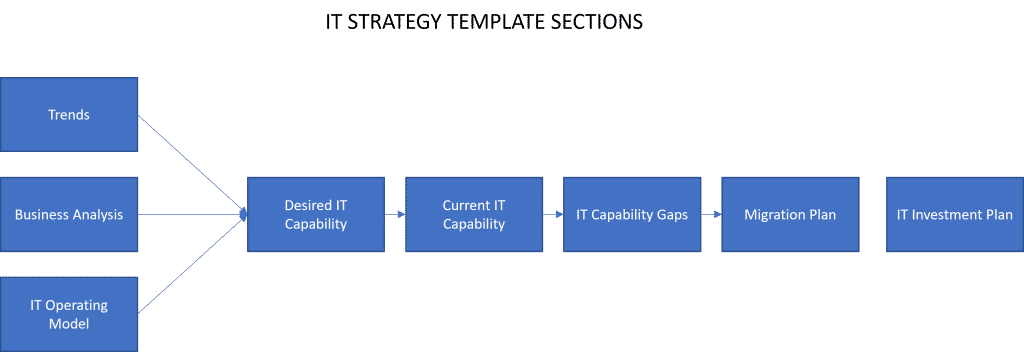
This IT Strategy Template is a fill-in-the-blanks planning framework for creating a complete IT strategic plan. It helps CIOs and IT leaders integrate and align business goals, IT capabilities, current-state analysis, future-state vision, initiatives, roadmap, budget, governance, risks, KPIs, and stakeholder communication into a single actionable strategy document. This template is structured into 23 sections, each a key component of a winning information technology (IT) strategic plan.
In practical terms, this template is designed to help an organization answer four core questions:
- Where are we now?
Through baseline assessment, business analysis, IT capability review, SWOT, spending, ROI, and current technology usage. - Where do we need to go?
Through IT vision, principles, objectives, future-state definition, and strategic alignment with business goals. - What gaps must we close?
Through gap analysis, business pain points, constraints, trend analysis, and capability shortfalls. - How will we execute and measure success?
Through initiatives, roadmap, implementation plan, budget, resources, governance, risk management, KPIs, communication, and review mechanisms.
This IT Strategy Template is a reusable CIO planning tool that guides the development of an IT strategic plan by linking business priorities to technology capabilities, identifying gaps between current and future states, and translating the strategy into funded, governed, measurable initiatives. It provides the format and structure your strategy needs to be actionable. Customize this IT Strategy Template to create a plan that fits your situation and requirements.
IT Strategic Planning Template
The New CXO Mindset
How to effectively use Information Technology to gain and maintain a competitive advantage
Sourabh Hajela
Information Technology Strategy Template
Session:
Chair:
Date:
Name: _____________________________________
Business Name: _____________________________________
Why do some organizations create unprecedented shareholder value using IT, while others are lost at sea? It is no secret that IT is a strategic weapon that can be used toward competitive advantage, what is often in doubt is how to make it happen. Can you say with certainty that you are getting the biggest bang for your IT buck? Can you prove it? If gaining sustainable competitive advantage is an imperative for you, read on. This IT Strategy Template will show you how to use IT for shareholder value…and we can prove it!
Section 1: Executive Summary
Purpose: The executive summary provides a concise and clear overview of the main points of the IT strategy. It's designed to give stakeholders who might not have the time or expertise to delve into the full document a quick understanding of the primary objectives, challenges, and actions defined in the strategy.
Section 2: Introduction
Purpose: The introduction gives readers context about the creation of the IT strategy, its intended audience, and the scope of its content. It also sets the stage for why the strategy is essential and how it fits into the organization's goals.
Section 3: Business Context & Strategic Alignment
Purpose: This section underscores the connection between the company's overarching goals and the IT initiatives. It clarifies that the IT strategy isn’t an isolated set of objectives but rather a vital component in realizing the broader organizational vision.
Section 4: Baseline
Q1. What are your top 5 business “pain” points?
These are things that you wish you had or had a solution for. Please put the first 5 things that come to mind.
Business “pain” points:
- ______________________
- ______________________
- ______________________
- ______________________
- ______________________
Q2. What are your top 5 business “objectives”?
For instance, the following are some common reasons that drive business strategy:
- Business objectives – forward action: Things that you must do to succeed
- Business objectives – risk mitigation: Things you must avoid to succeed
- Business objectives – overcoming roadblocks: Thing you must overcome to succeed
- Business objectives – other?
These can be short term or long term. They can be driven by revenue, cost, time to market, competitive advantage, risk or some other reason.
Business Objectives (Long Term/Short Term):
-
- LT/ST_________________
- LT/ST_________________
- LT/ST_________________
- LT/ST_________________
- LT/ST_________________
Q3. How do you plan to achieve these objectives?
For instance:
- If revenue increase is an objective, then enhancing the scope and reach of your distribution channel is an imperative. This can be achieved by going direct to customer or getting more distributors for your product.
- If reducing cost is an objective, then sending electronic statements can reduce printing costs
- If margins is the issue then selling direct can reduce broker/distributor commissions
| Opportunity | Imperative | |
| Revenue | ||
| Cost | ||
| Risk | ||
| Customer Satisfaction/Retention | ||
| Other |
Q4. What is in the way of achieving your imperatives?
For instance:
- If revenue increase is an objective, then enhancing the scope and reach of your distribution channel is an imperative. This can be achieved by going direct to customer or getting more distributors for your product. Complication: you do not have the money to invest
- If reducing cost is an objective, then sending electronic statements can reduce printing costs. Complication: you do not have the technology staff to pull this off
- If margin is the issue then selling direct can reduce broker/distributor commissions. Complication: you do not have the technology to pull this off or this will offend your current distributors who might leave.
| Imperative | Complication/Implication | |
| Revenue | ||
| Cost | ||
| Risk | ||
| Customer Satisfaction/Retention | ||
| Other |
Q5. What will we gain by leveraging IT capability across the business?
| Opportunity | Rationale | |
| Sales and Marketing | ||
| Manufacturing and Operations | ||
| Procurement | ||
| After Sales Service |
Section 5: Business Analysis
Q6. Who is your “customer”?
- What do you know about their demographics?
- What do you know about their psychographics i.e. behavior and preferences?
- How do you know your customer demographics and psychographics?
Customer Demographic:
Customer Behavior and Preferences:
Q7. What is our current business model?
Q8. What are the strengths/weaknesses/gaps in this business model?
Q9. What are the strengths, weaknesses, opportunities and threats facing your business?
| Strengths | Weaknesses |
| Opportunities | Threats |
Q10. What is each product’s profitability by market and channel?
| Market | Customer | Product | Purpose | |
| Instructions | “S”, “M”, and/or “L” | “C”, “B”, and/or “P” | List applicable products | “S”, “B”, and/or “V” |
| Direct | ||||
| Sales Force | ||||
| Brokers/Dealers | ||||
| Phone | ||||
| Wireless (Phone) | ||||
| Wireless (Palm/Other) |
Q11. What are some of the key areas in which your competitors are better than you? Is this “gap” of importance to our customer?
| Gap | Rationale | |
| Sales and Marketing | ||
| Manufacturing and Operations | ||
| Procurement | ||
| After Sales Service |
Section 6: IT Strategy Analysis
Q12. What is in the way of achieving your business imperatives?
For instance:
- If revenue increase is an objective, then getting more enhancing the scope and reach of your distribution channel is an imperative. This can be achieved by going direct to customer or getting more distributors for your product. Complication: you do not have the money to invest
- If reducing cost is an objective, then sending electronic statements can reduce printing costs. Complication: you do not have the technology staff to pull this off
- If margin is the issue then selling direct can reduce broker/distributor commissions. Complication: you do not have the technology to pull this off or this will offend your current distributors who might leave.
| Imperative | Complication/Implication | |
| Revenue | People: Process: Technology: Other: |
|
| Cost | People: Process: Technology: Other: |
|
| Risk | People: Process: Technology: Other: |
|
| Customer Satisfaction/Retention | People: Process: Technology: Other: |
|
| Other | People: Process: Technology: Other: |
Q13. Can IT help achieve your business imperatives?
| Complication/Implication | Solution | |
| Revenue | Application: Information: Infrastructure: |
|
| Cost | Application: Information: Infrastructure: |
|
| Risk | Application: Information: Infrastructure: |
|
| Customer Satisfaction/Retention | Application: Information: Infrastructure: |
|
| Other | Application: Information: Infrastructure: |
Q14. What will we gain by leveraging IT capability (selling, manufacturing, buying or servicing) across the business?
| Opportunity | Rationale | |
| Sales and Marketing(Hint: Usually the opportunities are on the revenue and some on cost side) | ||
| Manufacturing and Operations(Hint: Usually the opportunities are on the cost side) | ||
| Procurement(Hint: Usually the opportunities are on the cost side) | ||
| After Sales Service(Hint: Usually the opportunities are on the cost and customer retention side) |
Section 7: Environment Trend Analysis
Q15. Top 5 business trends? Which of these will affect you? How?
| No. | Trend | Impact | Rationale |
| 1 | |||
| 2 | |||
| 3 | |||
| 4 | |||
| 5 |
Q16. Top 5 technology trends? Which of these will affect you? How?
| No. | Trend | Impact | Rationale |
| 1 | |||
| 2 | |||
| 3 | |||
| 4 | |||
| 5 |
Trend analysis leads to the creation of business impact statement and risk mitigation strategy.
Section 8: Current IT Capability Analysis/Current State Assessment
Purpose: This section offers an objective evaluation of the organization's present IT landscape, including its strengths and potential areas for improvement. It serves as the baseline from which future initiatives and improvements will be launched.
Q17. How much do you spend on it? (Is it the largest single investment?)
1. Where do you spend that money? (categorize that spend)
2. Why? (How much have you earned from it?
Q18. What is your technology ROI?
Q19. Does your company have a plan for technology?
Q20. Does your business plan include a technology plan?
Q21. Where is IT being used across your business?
| IT Capability | Rationale | |
| Sales and Marketing(Hint: Usually the opportunities are on the revenue and some on cost side) | Application: Information: Infrastructure: |
|
| Manufacturing and Operations(Hint: Usually the opportunities are on the cost side) | Application: Information: Infrastructure: |
|
| Procurement(Hint: Usually the opportunities are on the cost side) | Application: Information: Infrastructure: |
|
| After Sales Service(Hint: Usually the opportunities are on the cost and customer retention side) | Application: Information: Infrastructure: |
Section 9: IT Vision & Principles
Purpose: What you aim to achieve with IT in the long term. Set of beliefs or values to guide IT decision-making.
Section 10: IT Objectives & Goals
Purpose: Specific, measurable, achievable, relevant, and time-bound (SMART) objectives to align IT initiatives with business goals.
Section 11: IT SWOT Analysis
- Strengths: IT capabilities that provide a competitive advantage.
- Weaknesses: IT areas that need improvement.
- Opportunities: External factors that the IT department can capitalize on.
- Threats: External factors that could harm IT operations.
Section 12: Future State Vision
Purpose: This section articulates the aspirational future of the organization's IT environment, highlighting the advancements and improvements aimed for. It provides a clear target for the organization and helps align efforts toward achieving a cohesive end state.
Section 13: Gap Analysis
Purpose: This section aims to identify, analyze, and quantify the differences between the present IT conditions and the envisioned future. It's the foundation upon which the actionable road map of the IT strategy is built.
Section 14: Initiatives and Projects
Overview: This section will detail the specific IT projects or initiatives that are planned or proposed to address the identified gaps (from the Gap Analysis) and to achieve the outlined strategic objectives. Each initiative should have a clear scope, objective, timeline, budget, and designated responsibilities.
Section 15: Implementation & Execution Plan
Purpose: To provide a structured, chronological plan of activities that will be undertaken to achieve the IT strategy's objectives. This plan ensures that there's clarity on what needs to be done, by whom, and by when.
Section 16: Technology Initiatives & Roadmap
Purpose: To present a clear set of technology initiatives that bridge the gap between the current and desired future. The roadmap should offer a chronological blueprint of actionable steps, milestones, and deliverables.
Section 17: Budget & Resources
Purpose: To provide a clear picture of the monetary and human resources required for the execution, maintenance, and support of the technology initiatives. This ensures the organization’s readiness to commit necessary resources, avoiding potential roadblocks or resource constraints.
Section 18: Performance Metrics & KPIs
Purpose: To define clear, measurable indicators of success for the IT strategy. This allows for objective progress tracking, assessment of various initiatives' impact, and adjustments based on empirical data.
Section 19: Stakeholder Engagement & Communication
Purpose: To outline a systematic approach to keeping all stakeholders informed, involved, and aligned with the IT strategy. Engaging stakeholders ensures the strategy is accepted, understood, and supported, paving the way for smoother implementation and adoption.
Section 20: IT Governance & Management
Purpose: To establish a clear framework for decision-making processes, responsibilities, and controls in the IT landscape, ensuring alignment with business objectives, responsible use of resources, and risk management.
Section 21: Risk Management
Purpose: To methodically address the IT-related risks that could impact the organization's ability to achieve its objectives. This involves identifying potential risks, assessing their likelihood and impact, and putting measures in place to manage them.
Section 22: Conclusion & Next Steps
The Conclusion & Next Steps section succinctly summarizes the IT strategy document and outlines immediate actions and directions. It reaffirms the document's significance and motivates stakeholders to move from planning to action.
Section 23: Review and Update Mechanism
Overview: This section will establish the mechanisms, timelines, and criteria for IT strategy review and update. It provides guidelines on how and when to reassess the strategy to ensure its continued relevance and effectiveness.
What do you think? Let us know if there are ways to improve this IT Strategy Template by posting a review.